
Choosing a nursery school can feel uncertain when your child is learning more than one language. You may wonder whether teachers will understand what your child needs, how friendships will begin or what will happen if your child feels upset and cannot find the words to ask for help. Supportive teaching does not depend on a child speaking fluently from the first day. It begins with adults who listen, notice different ways of communicating and work with you to help your child feel secure.
Knowing what that support can look like makes it easier to talk with teachers about your child’s needs. There is no single path or fixed pace for learning languages, but there are practical approaches that can help children understand, participate and build confidence.
What language learning may look like in nursery school
Children communicate in more ways than speech
Young children express themselves through gestures, facial expressions, pointing, sounds and play as well as spoken words. A child may also use a familiar word from home when the adults or children around them speak another language. Each of these is a useful clue about what the child is thinking or needs.
For example, a child might point to a cup without saying anything. A responsive teacher can acknowledge the request, point to the cup and say, “You want water,” while helping the child get a drink. The child’s message has been understood, and they have heard words connected to a meaningful moment without being required to repeat them.
Children’s experiences and progress can differ
Some children start using words in a new language readily. Others may spend time watching and listening, relying on gestures or speaking less than they do at home. A child may be confident during a familiar circle but quieter in a large group. All of these observations can help a nursery school understand how to support participation.
Being quiet can be part of adjusting to an unfamiliar setting, but it should not automatically explain every communication difficulty. If you have ongoing concerns, talk about what you notice rather than assuming that learning another language is the cause. Teachers at ICCC will share with parents if they are concerned about the child’s communication or another area of development.
How teachers help children understand and feel understood
Build security through relationships and predictable routines
A trusting relationship gives a child someone to turn to when words are hard to find. A warm greeting, an adult who notices signs of discomfort and a familiar way to ask for help can make the day feel more manageable. Teachers can also watch for the individual signals a child uses, such as reaching for an adult’s hand when they need reassurance.
Predictable routines offer helpful clues when language can’t help. If a teacher uses the same gesture before snack time or shows children where to put their bags each morning, a child can begin to understand what comes next. When visiting a nursery school, ask how staff get to know new children and how they comfort a child who is upset. You can also meet the ICCC teaching team and discuss how they support children as they settle in.
Use clear speech, gestures and visual support
Teachers can make their meaning clearer by using short, natural sentences and connecting words with what a child can see. Holding up a coat and saying “Coat on,” for example, gives the child both a spoken cue and a visual one. Demonstrating how to wash hands and using words like “We rub the soap in”, makes everyday language easy to learn.
Time to respond is important too. A child may need a moment to understand, decide what they want to communicate and find a way to respond. Patiently waiting, rather than repeating the question immediately or answering for them, gives the child space to participate.
Recognise and value the home language
A child’s home language is part of their connection with family and their way of understanding the world. ICCC teachers do not speak every language but they can show that they value it. They can ask you for a few useful words, check how to pronounce your child’s name and learn the expressions your child uses for comfort, food or toileting.
A supportive nursery school can also welcome communication in whatever form a child has available. If your child uses a word from home, points to an object or combines words from different languages, an adult can respond to the meaning rather than treating the attempt as a mistake.
How children practise language through everyday experiences
Make words meaningful through hands-on activities
Hands-on learning gives children a reason to communicate about something they can see and touch. While building a tower, a teacher might say, “A big block,” or “It fell down,” and follow the child’s interest as they rebuild it. During painting, the adult might name a colour, describe a brush moving across the paper or respond when the child holds up their work.
The aim is not to turn play into a test. A child who is listening, choosing materials, pointing or copying an action is taking part, even if they do not repeat every word. If you would like to see the wider context for children’s learning, you can explore the ICCC learning programme and ask how activities are adapted for children with different language experiences.
Use stories, songs and repetition
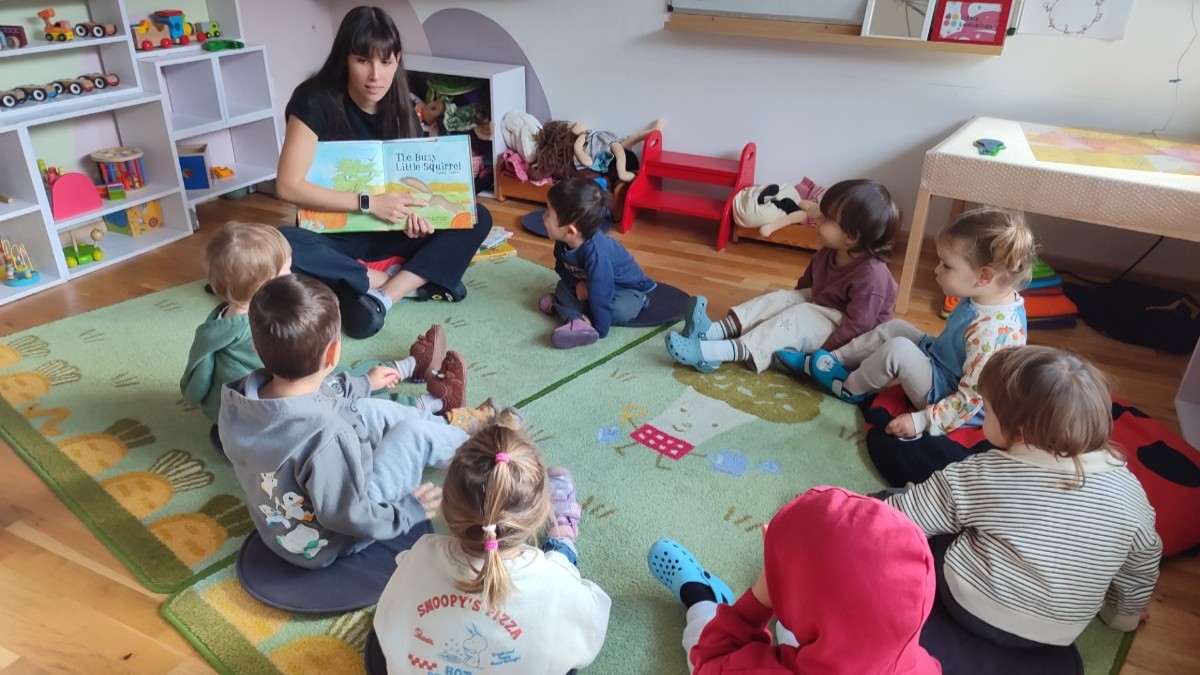
Pictures and repeated phrases help children connect language with familiar ideas. In a story about animals, a teacher can point to a picture, make an animal sound and pause so children can respond in their own way. A child might point, make the sound, say a word or simply watch. Each response gives the adult information about the child’s engagement. Using the same book repeatedly helps children figure out the meaning of new vocabulary and remember words.
Songs can work in a similar way, especially when actions help show what the words mean. If practical, you might share a favourite book or song in your home language with the nursery school. Familiar stories can offer reassurance while also giving teachers something meaningful to talk about with your child. You can also explore the role of books in early childhood.
Support joining in and sharing with other children
Children do not need fluent shared speech to begin enjoying one another’s company. Two children might build side by side, roll a ball back and forth or take part in the same pretend activity. A teacher can help by showing how to join in, noticing an invitation to play and giving each child a manageable role.
When teaching sharing to preschoolers, adults can also model short phrases such as “My turn,” “Can I have it?” and “You can use it next,” alongside pointing or an open-hand gesture. A teacher might help one child explain that they are still using a toy and help the other find a way to wait or choose something else. The goal is to support both children in expressing their needs and negotiating, not to expect immediate sharing or fluent speech.
How parents and teachers can work together
Tell teachers what helps your child communicate
You know details about your child that may not be obvious in a new setting. Tell the nursery school which languages your family uses, how your child asks for help and which words they use for a drink, a favourite comfort item or the toilet. You can also explain what your child enjoys, what tends to upset them and what usually helps them settle.
Share any existing developmental concerns or professional support as well. For example, if your child is already working with a speech and language therapist, you can discuss which information or strategies would be useful to share with teachers. You do not need to have every answer; the conversation gives you and the staff a starting point.
Keep using the languages that feel natural at home
You can continue speaking the language or languages you know and use comfortably at home. Everyday conversations give your child opportunities to connect, share ideas and communicate with people who matter to them. There is no need to stop using a home language simply because your child is learning another one at nursery school.
Language support can fit into ordinary family life. Talk about the food you are preparing, name things your child notices on a walk or return to a favourite story at bedtime. Follow your child’s interest and leave room for them to respond with words, sounds or gestures. These moments can be warm and enjoyable rather than feeling like extra lessons.
Questions to ask a nursery school about language support
A visit or conversation with staff is an opportunity to understand how support works in everyday situations. You can take these questions with you and add anything specific to your child:
- How do staff comfort an upset child who cannot yet explain what they need?
- How do you learn about and value the languages a child uses at home?
- How do you help a child join other children’s activities?
When to ask for additional guidance
If you are worried about communication, begin by comparing observations with your child’s teachers. Consider how your child expresses needs, understands familiar requests and interacts with others at home as well as at nursery school. Tell staff what you notice in each language your child uses, including situations where communication feels easier or harder.
If concerns persist, or if you notice difficulties across settings or languages, consider discussing them with a qualified healthcare professional or speech and language therapist. They can help you decide whether further assessment or support would be useful. Learning more than one language does not itself cause a language disorder. You do not have to determine the cause on your own before asking for guidance.
Frequently asked questions
Should we stop speaking our home language when our child starts nursery?
Absolutely not. Continue using the language or languages in which your family communicates comfortably. Conversations, stories and songs allow your child to express ideas and stay connected with the people around them. You can share useful words with teachers while also allowing your child to hear and use the nursery school language during everyday activities.
What if my child does not speak much at nursery?
Ask teachers how your child participates throughout the day, including whether they point, use gestures, play alongside others or seek help from an adult. Children’s experiences differ, and a child may need time to feel comfortable in a new setting. If concerns continue or you notice communication difficulties in other settings or familiar languages, speak with a qualified professional.
How can teachers help my child make friends without fluent shared speech?
Teachers can bring children together around an activity, model a gesture or offer a few useful words at the moment they are needed. Building with blocks, looking at a book or rolling a ball can create opportunities to connect without requiring a long conversation. Relationships can begin through shared participation as well as speech.
Small steps toward confident communication
A supportive nursery school helps children feel understood while giving them meaningful opportunities to hear and use language. Attentive relationships, visual cues, play and conversations with families all help teachers respond to the child in front of them, rather than expecting every child to follow the same path.
If you would like to discuss your family’s circumstances, you can contact ICCC with questions about language and other support.

Snezhana Daneva is a Director at ICCC since September 2010. She gained experience in teaching, marketing and client relations, as well as cultural diplomacy and regional project management after a diverse career at the British Council in Bulgaria and in the UK. She worked as a volunteer in not-for-profit organizations related to child birth and child care.
Snezhana has MA in Education Management and MA in English and American Studies from Sofia University, and Management Certificate and Diploma from Open University, UK. Her recent Education Management degree thesis focused on children’s social-emotional development in the early years, comparing government standards and practice in Bulgaria and in the United Kingdom.