
School Year 2026-2027
Welcome to the ICCC e-Parent Handbook for 2026-27 school year. This handbook is designed to provide families with all the information they need throughout the school year and about important policies that help ensure the wellbeing of kids, families and staff at ICCC. Click on any section below to learn more.
(Section 1) School Year Calendar - Important Dates and Events in 2026-27


Section (2) New Parents - Welcome Letter
Welcome to ICCC! Our team will do our best to help you and your child feel at home in our big family! We are committed to supporting your child feel safe, happy to discover the world, and to make new friends.
If this is your child’s first experience in a school setting:
Settling in – what to expect
Although this is an exciting time, the transition from home to nursery can be challenging for children when they first start. You can anticipate change in mood and behaviour; sleep and appetite can be affected too. This stage typically lasts 1-4 weeks. As a parent, it’s natural to feel concerned and wonder how you can support your child during this important period of their life. We offer some valuable tips to help your child settle with ease, fostering a positive and comfortable experience for both yourself and your child.
Before the first day
Your class teacher will contact you to discuss the arrangements for the first day and ask you to share your child’s relevant information. Share any pertinent information about likes, dislikes, interests, or any specific needs they may have. This will help our team in understanding your child better to help them settle in and tailor activities to their individual preferences, when possible. Talk with your child about starting preschool and show them pictures.
Introduce a familiar routine with mealtimes and nap times, similar to the schedule they will follow at ICCC (arrival by 9.15am, lunch at 12pm, nap time 12.45pm, afternoon snack 3pm). This routine will help your child adjust more easily to the environment of the nursery.
Encourage your child’s independence in daily activities like dressing themselves, using the bathroom, or carrying their bag. This will boost their confidence and make them feel more capable in the nursery setting.
The first weeks
A gradual introduction will enable your child to become familiar with the routine, environment, and staff, minimizing any overwhelming feelings.
Day 1: On the first day, we invite one parent to stay with their child during the morning, typically for one or two hours before lunch. Your child ca explore the environment and interact with other children and staff while you are nearby. This helps reduces anxiety, and supports a smoother transition in the following days when they begin attending independently.
Day 2-5: The child spends between 1 and 2 hours at nursery without a parent or caregiver. The teachers will monitor closely the child and each day plan the schedule for the next.
After the first week, we will discuss if the child is ready to extend the stay to include lunch, and gradually full days after the first few weeks.
What you need to bring:
- Indoor shoes and a bag with change clothes which will stay at school. If the child is on diapers, you should bring a supply of your regular diapers and wet wipes.
- Optional – comfort object or blanket, especially for nap time; pajamas for children on full day schedule.
Please make sure you have ready for the first day all tests results and medical documentation for your child, as described in Section (4) of this Handbook.
Section (3) Forms and authorisations to complete before the start of the school year
Parents must complete before the start of the school year all the forms below for each child enrolled at ICCC, to allow staff to perform their duties.
Section (4) Medical documents, health check and lab tests to prepare for the first school day
(4) Medical documents
To ensure a safe and healthy environment for all children, Bulgarian Health authorities have strict admission requirements, as well as return-to-school requirements each September, explained below. Parents must take action to obtain all necessary health documentation and lab tests before the child’s first school day. Lab tests should be done no earlier than 15 days before the first school day. We recommend you visit the doctor within this period as well.
(4.1) Medical Documents Required for Admission
Before your child starts attending ICCC, please provide the following documents needed for their medical records at ICCC:
- A copy of the child’s birth certificate.
- A completed health and preventive care record (здравно-профилактична карта), completed by the child’s GP or another qualified physician.
- The above document should include information confirming that the child has received all mandatory vaccinations and revaccinations required for their age, together with information on the vaccinations and revaccinations administered.
- A negative test result for pathogenic intestinal bacteria (Shigella, Salmonella and E. coli) and intestinal parasites, carried out no earlier than 15 days before the child’s first day at ICCC.
- Blood and urine tests
If you don’t have a GP, we recommend visiting Nuviva medical center which is conveniently located for ICCC, or another provider linked with the National Health Information System.
For the lab work, we recommend having with you ready stool sample, urine sample and pinworm tape sample. Containers / microscopic glass can be bought from Apteka. All major blaboratories are familiar with what is required for starting nursery/kindergarten and may offer special packages.
(4.2) Medical documents required for returning students at the start of the new school year
- A completed health and preventive care record (здравно-профилактична карта), completed by the child’s GP or another qualified physician – required for all children, no matter if they attended over the summer, or not).
- The above document should include information confirming that the child has received all mandatory vaccinations and revaccinations required for their age, together with information on the vaccinations and revaccinations administered.
- In the case of absence for more than 1 month prior to resuming school, you should also provide negative test result for pathogenic intestinal bacteria (Shigella, Salmonella and E. coli) and intestinal parasites, carried out no earlier than 15 days before the child’s first day at ICCC.
Important!
If your child has a GP (all children with Bulgarian citizenship should have GP), please also check with them that your child’s electronic records in the National Health Information System (НЗИС) are up to date before the end of September.
Both international and local families must comply with the regulations. Sanctions can be imposed on the school and on the family when documentation is lacking or is incomplete.
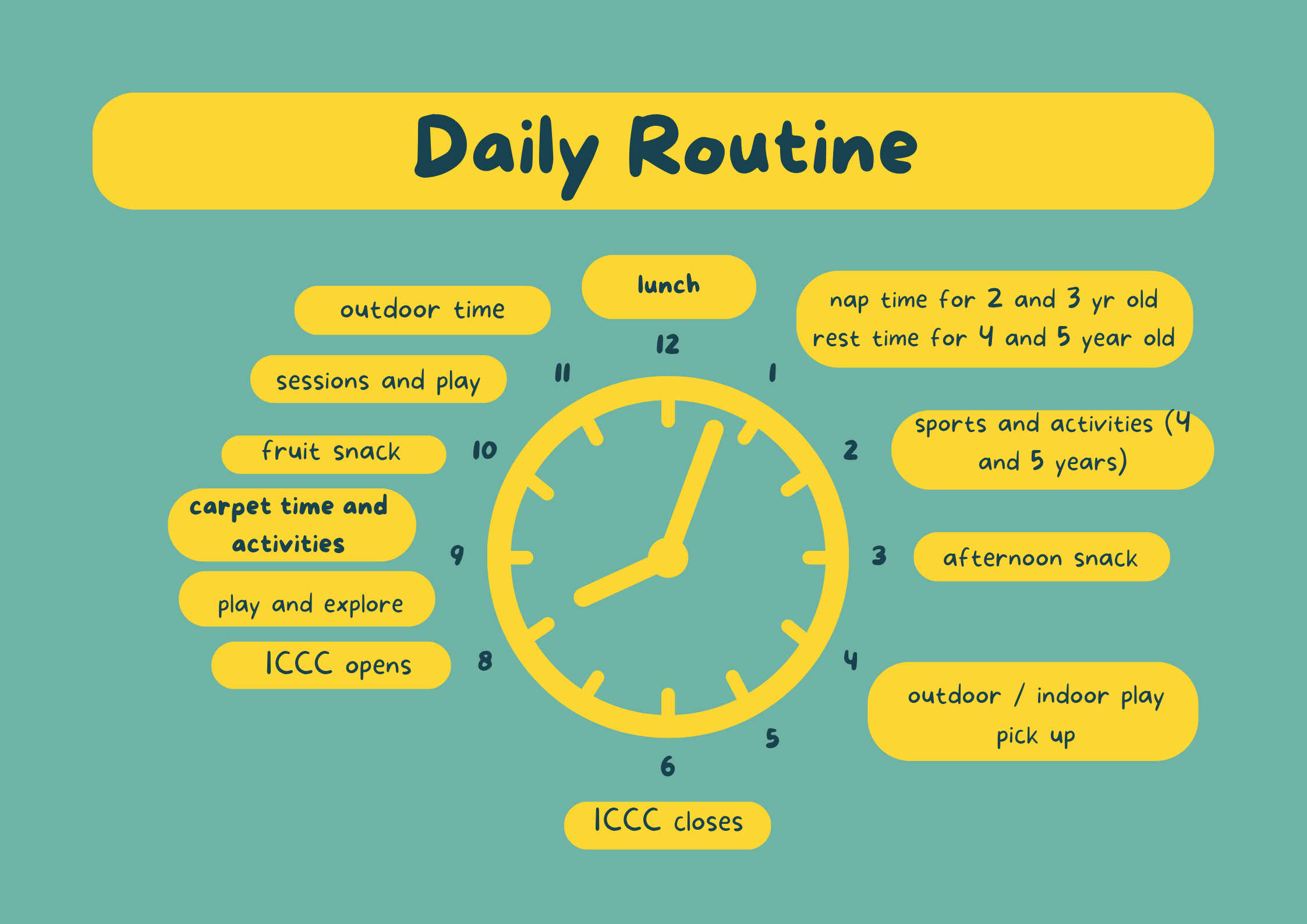
Section (5) Daily Routine
This shows a typical day at ICCC. Activities and timings vary for each age group. Your class teachers will introduce you to the daily routine at the parent information meeting at the beginning of the school year.
Section (6) Class Teachers, Special Teachers and Classrooms
🐞 Little Ladybirds group (2 – 3 years)
Ms Irina Radeva, lead teacher; Ms Kalina Larry (school nurse and teacher assistant); Ms Stella Antonova (teacher, tbc)
Classroom: 1st floor left
Entry to building: ground floor, glass door next-to-kitchen
🐝 Big Busy Bees group (3-4 years)
Ms Svetoslava Ralcheva (lead teacher); Ms Yana Eneva (teacher assistant)
Classroom: 1st floor right
Entry to building: main entrance on ground floor
🐥 Cheeky Chicken group (4 – 5 years)
Ms Petya Petkova (lead teacher); Ms Vesela Gerasimova (teacher assistant)
Classroom: 2nd floor right
Entry to building: ground floor, glass door next-to-kitchen
🐱 Clever Kittens group (5 – 6 years)
Ms Melissa Carol Didier (lead teacher); Ms Tsvetelina Tsvetkova (teacher)
Classroom: 2nd floor left
Entry to building: from main entrance on ground floor
Specialist Teachers
Ms Nadejda Miteva — Music
All groups: Mondays, Wednesdays & Fridays
Mr Takeshi — Physical Education
Little Ladybirds & Big Busy Bees: Tuesdays
Mr Yavor Denchev — Science
Cheeky Chickens & Clever Kittens: Thursdays
Ms Lilly Peychevska — Dance
Cheeky Chickens & Clever Kittens: Mondays & Wednesdays
Sensei Mitko Dinev — Aikido
Cheeky Chickens & Clever Kittens: Tuesdays & Thursdays
Section (7) Communication With Families
Good communication, mutual respect and trust are vital to the functioning of ICCC, and to the well-being of our children.
- To keep parents informed, we use the learning application Kinderpedia, Viber groups, and email. Parents will receive invitations to join Kinderpedia and Viber at the start of the school year.
- In September we hold parent information meetings for each group. Teachers share key priorities for the year, the main organizational aspects and how parents can contribute and cooperate.
- Teachers share daily stories and highlights from children’s school life and learning in Kinderpedia and Viber.
- Development tracking and reporting the children’s progress is also done through Kinderpedia. Parents will receive two formal reports for their child’s development – mid-term in February and after the end of the school year.
- Following the mid-term report, we organize one-to-one parent teacher conferences to discuss your child’s progress and next steps.
- Also, we strongly encourage the day-to-day exchange between parents and teachers at drop off or pick up.
- Special events are another way we keep parents involved and build a strong parent community. Such events are the Welcome Back BBQ at the end of September, the Winter Holiday Party in December, and the Learning Celebration Day in June. We may organize additional events, such as coffee mornings, social evenings, or parent project days throughout the school year.
- Finally, parents are highly encouraged to participate in their child’s learning activities at ICCC. Whether it is to read a story, or introduce the group to a national holiday from the child’s home country, do a workshop with children, or talk about their job, parents are welcome to be part of children’s school day and learning.
When issues arrise, we encourage parents to raise them with the class teachers who may organize a separate meeting to discuss and address the problem. If the issue is not resolved, parents can address it to the school Director, and finally to the Parent Board. If necessary, a Board member will be appointed to meet the parents and help resolve it to the best of everyone’s interests.
Section (8) Positive Discipline at ICCC
At ICCC, we use a Positive Discipline approach in the classroom, helping children develop emotional awareness, self-regulation, relationship-building skills, and responsible decision-making. Based on Adlerian principles of psychology, Positive Discipline recognizes that children have a natural need to belong, to feel accepted, and to be valued as members of their community. When their developmental needs and abilities are understood and supported by adults, children are more likely to cooperate and engage positively with others.
When challenging or disruptive behaviour occurs, we seek to understand its underlying cause and use appropriate Positive Discipline strategies to help children regulate their emotions, meet their needs appropriately, and return to cooperative behaviour.
Some of the Positive Discipline tools we introduce in the classroom at the beginning of the school year include class agreements, emotions chart, wheel of choice, calm corner, classroom jobs, and class meetings, among others. These tools help children understand expectations, develop the skills to manage their behaviour, and contribute to a classroom environment where everyone feels safe, supported, and able to learn and play.
We expect parents to support their child in developing cooperative behaviour at school and, when persistent behavioural concerns arise, to work collaboratively with ICCC teachers and staff to ensure the safety, well-being, and learning of all children. Where appropriate, we may recommend consultation with a qualified specialist and establish an individual improvement plan with the family, allowing a reasonable period for progress to be made.
If a child’s behaviour does not improve despite appropriate support and collaboration, and continues to pose a significant safety risk or substantially disrupt the learning and well-being of others, ICCC may initiate its internal procedure for discontinuing the family’s membership at ICCC.
Section (9) Health and Sickness
ICCC takes the health of all our children very seriously. We have a qualified medical nurse (Ms Kalina, LLB teacher assistant) in charge of medical records, health measures and procedures. The school nurse performs regular general health checks and will inform parents of any health related concerns that may need to be addressed.
We strictly enforce the following policies and procedures.
1. Before the start of each school year in September all children should present the following medical records:
- ‘Zdravno profilactichna karta’ from your GP or pediatrician with all vaccination records. Vaccination records are provided separately if they are not listed in detail in the ZPK statement.
- Note from GP or pediatrician for lack of contact with infected persons
For new children only:
The above and lab tests which health authorities require for each child before they start nursery or kindergarten (details are described in the Welcome Letter for new parents above, and here).
2. Sickness Protocol
If a child appears to be unwell or sick when dropped off, the school nurse or a member of staff may request that the child is seen by a doctor before attending school for the day.
If a child develops symptoms in the course of the day, the school nurse or a staff member will call parents to collect the child as soon as possible. The child may be separated from other children while waiting to be picked up.
2.1. А child with fever above 37.3C or flu like symptoms will not be admitted to school. Parents should not give medication to lower fever before the child arrives to school.
Other typical signs of illness may present as runny nose, flushed cheeks, coughing, rapid or difficulty breathing, fatigue, extreme fussiness, stomach pain or diarrhea/vomiting, skin rash of unknown origin.
2.2. Parents are requested to phone/email the school between 8:30am and 9:30am if a child is unwell and/or will be staying away from school, especially if an infectious disease is suspected.
2.3. Children MUST BE KEPT AT HOME in the following situations:
- Runny nose: it is often the first symptom of viral or bacterial infection. We recommend either a visit to your doctor, or keeping the child at home for 2-3 days to see if other symptoms like temperature or coughing will appear.
If there is thick yellow or green mucus the child should be tested for bacteria and treated, if necessary. This measure helps prevent the bacteria spreading to other children or staff.
- Fever within the last 24 hours.
Children should be kept home for a minimum of 24 hours after return to normal temperature. This ensures that the temperature relief is not temporary and the child will not infect other kids on their return to school.
- Flu-like symptoms: extreme runny nose, coughing, temperature, sore throat.
- Extreme tiredness or irritability of an unexplained nature.
- In the case of strep infection, scarlet fever, chicken pox or other communicable diseases, children can return to school only with the doctor’s permission, certified with a doctor’s note and in the case of scarlet fever, a negative strep A test result.
- Vomiting / diarrhea – at least 24 hours without vomiting or diarrea before returning to school.
- Rash of unknown origin
- Children having head lice should be kept away from school until they have been treated to eradicate the problem. If a teacher finds head lice, ICCC will send the child home. We will also check all other children and inform parents in the group.
- Further reading: Notes from webinar for ICCC parents with pediatrician Dr. Boyana PETKOVA open here
3. Accidents
Although staff members are constantly monitoring children and doing their best to prevent accidents, injuries can happen. We have a protocol in place which involves documenting injuries and notifying parents.
In the event of illness or serious injury at ICCC, staff will:
- Decide whether to summon medical assistance (staff have been trained in CPR and we have emergency numbers for local hospitals).
- Contact the parent(s) who will collect the child as quickly as possible.
4. Medication
ICCC staff are prohibited by law to give medication to children.
Section (10) Meals and Nutrition
ICCC uses a licenced caterer for lunch and snacks offered at school. Catering is charged extra except for absence days when we have been notified no later than the day before.
We are bound by health authority regulations not to allow bringing food from home, unless when a child is on special diet which cannot be provided by the school catering.
Our catering includes a healthy variety of morning and afternoon snacks, and three-course lunch consisting of salad, soup and main course.
For morning snack there is a variety of three kinds of fresh seasonal fruits – bananas, apples, pears, grapes, cherries, melon, water melon, peach, orange, tangerines, and more. The afternoon snacks include yoghurt and musli/chia, cous cous, pancakes with cheese or honey, cheese sandwich and veggies, fruit/cheese muffins or oat buscuits.
Parents can see the daily menu on the school application Kinderpedia
Section (11) Drop Off and Pick Up Policy
Guidelines for Parents on School Premises
We ask all parents to follow the guidelines below when on school premises. They are important for the well-being and safety of children, teachers, and families, as well as for the smooth running of ICCC.
Getting to ICCC
- Parents should use the lower gate for drop-off and pick-up. Access through the upper gate should be limited to exceptional circumstances, such as a temporary road blockage or severe winter weather.
- We recommend accessing the lower road to school from Snejina Elena Street or Naum Street, and turning left at Dalida Restaurant. The other route, where you turn left from the Vitosha Mountain road towards Dalida Restaurant, is currently in need of reconstruction, following severe damage caused by heavy traffic and flooding. We are waiting for the local council to take action to repair it.
Driving speed
- Always drive slowly and carefully on our road. Speeding creates a significant safety risk for children and families and can also negatively affect our relationship with our neighbours.
Parking times and stay on school premises
- Please aim to spend no more than 10 minutes on ICCC grounds during drop-off and pick-up. Parking space is limited, and keeping visits brief helps ensure that spaces remain available for other families, particularly during busy periods.
- We ask parents to observe this measure strictly to also allow children to transition into and out of the school environment quickly. Children may behave differently in the presence of their parents. They may take more time to settle in at the beginning of the day, or be less likely to follow the agreed classroom and outdoor safety rules. This can create unnecessary safety and behavioural challenges.
Prompt arrival for classes
Late arrival is disruptive for class activities, and limits the benefits of the child from the program and the learning activities in the morning. At the beginning of school year the teachers will introduce the learning schedule and the expected arrival times for each class. Children arriving later may be asked to wait outside the classroom with parents to avoid interrupting activities.
Self check-in / check-out with QR Code
Parents are required to check their children in and out of school when dropping them off and picking them up. This can be done through Kinderpedia using the QR code available at each entrance.
Section (12) Absence reporting
Absence
Please inform the teachers in advance if your child will be absent from school for family or health reasons. Unexpected illness-related absences should be reported by 9:30 a.m., where possible.
To report an absence, please send a quick message to your class teachers through Kinderpedia with the subject line “Absence” and indicate the dates of the absence. If the notification is received the day before, the absence will be registered as excused. You will not be charged for catering during excused absences.
After an absence due to illness that has required a visit to the doctor, parents should provide a medical certificate confirming that the child is fit to return to school. In the case of scarlet fever, chickenpox, or other communicable diseases, a medical certificate confirming that the child may return to school is mandatory.
Section (13) Clothing
- Each child should have at school a small bag containing a complete set of clothing, including underpants and socks. All clothing should be labelled with their name.
- Indoor shoes are required for all children; these could be slippers or some other form of comfortable footware.
- Extra clothes are stored in each child’s cubby in the corridor, and shoes are kept in the shoe box in the entry area.
- Parents should provide comfortable clothes and shoes for outside play and activities – especially running, jumping and climbing (no flip flops or slippery shoes).
- Parents should provide appropriate seasonal outdoor clothing so children can play outdoors in all kinds of weather (hats, mittens, overalls, rainpants and water proof winter clothing and footwear).
- For children still in diapers parents should provide a sufficient supply of the child’s regular diapers and wet wipes each week.
- All clothing items and shoes/boots should be LABELLED with the child’s name. This helps children and staff keep belongings organized, and identify misplaced items and identical clothing/footware.
Section (14) Toys at School
We ask parents not to send children to school with toys from home, or similar belongings. They are often the cause of small conflicts and may get lost or broken. If children do bring a toy, it will be left in a special ‘toy hotel’ in the corridor.
Each Friday is toy sharing day and children are welcome to bring toys to school, share why they are important or special to them, and enjoy playing with the toys woth other children.
Section (15) Celebrating Birthdays
We are happy to celebrate each child’s birthday at ICCC. Parents are welcome to bring cupcakes or a small birthday cake to share with their child’s group at snack time. You must ask the shop to provide a certificate, required by the health authorities.
We do not allow outside entertainment (clowns, puppets, etc.) for birthdays. We organize a birthday celebration during class time when we sing songs, dance, and play games.
We do not allow additional candy/sweets bags or other gift bags to be presented to other children on the occasion of the child’s birthday. The birthday child can donate a book to the school library to mark their birthday if they wish, with a suitable inscription inside.
Section (16) School Bus
ICCC has a small bus that runs from September to June (within the school year dates). It is equipped with age appropriate child safety seats and accompanied by supervising member of staff. Pick up is from your address or an agreed location along the bus rout, if we are unable to offer bus service to your location.
School bus requests are collected at the end of each school year and over the summer (request form). Parents will be informed about the timings, the extra fees, and other important logistics, a few weeks before the strat of the school year.
Parents who opt for school bus services should commit to using the bus for the whole school year.
Section (17) Contact Information
ICCC Address: 20, Akademik Hristo Hristov Street; Dragalevtsi, Sofia 1415
email: office@iccf-bg.com; teachers@iccf-bg.com
Director: Snezhana Daneva, Tel. +359 879403677
Below are the contact phone numbers for each group. The class Viber group is administered from the respective number.
• Little Ladybirds: +359 879403675
• Big Busy Bees: +359 879403678
• Cheeky Chickens: +359 877491169
• Clever Kittens: +359 879403676
If you need to call or send a message to the class phone, the teachers will check and respond at certain times in the day. or when able to. The staff responsibility to children always takes priority..
If your call or message is urgent you can use Director’s number +359 879403677
Section (18) Safeguarding Policy
At ICCC we recognize our duty to protect children from harm. The following are some of the principles that guide our safeguarding policy and procedures.
- We provide an environment where children feel secure, valued, respected and listened to.
- We use the Positive Discipline approach in the classroom, helping children develop emotional awareness, self-regulation, relationship-building skills, and responsible decision-making.
- We ensure that all staff are aware of their duty of care, they follow our ethical code of practice and our safeguarding procedures.
- We expect children and parents to treat each other, and staff members, with respect.
- We expect parents to cooperate with staff to solve any discipline or other issues.
Section (19) ICCC Board of Directors and AGM
The ICCC Board of Directors consists of five elected members, all of whom are parents of children currently attending ICCC. The Board includes a Chairperson and four additional members, all with equal voting rights.
The Board is responsible for the long-term sustainability and strategic policies of ICCC. Its responsibilities include contributing to marketing and community initiatives, organizing social events for parents, overseeing the budget, and helping to address issues and resolve conflicts when needed. Parents are encouraged to communicate with Board members about matters of concern, particularly with the Board member representing their child’s group.
New Board members are elected each September at the Annual General Meeting (AGM). Parents interested in joining the Board are invited to express their interest and share their relevant experience or qualifications with the Board Chairperson or Director. All ICCC members are entitled to vote at the AGM, either in person or through a designated representative.
The 2026 Annual General Meeting (AGM) will take place on 29 September at 6:30 p.m. Members will receive an invitation and the meeting agenda by email at least one month before the meeting date.
This statement of acknowledgement must be completed after parents familiarise themselves with all sections and policies laid out in this e-Handbook.