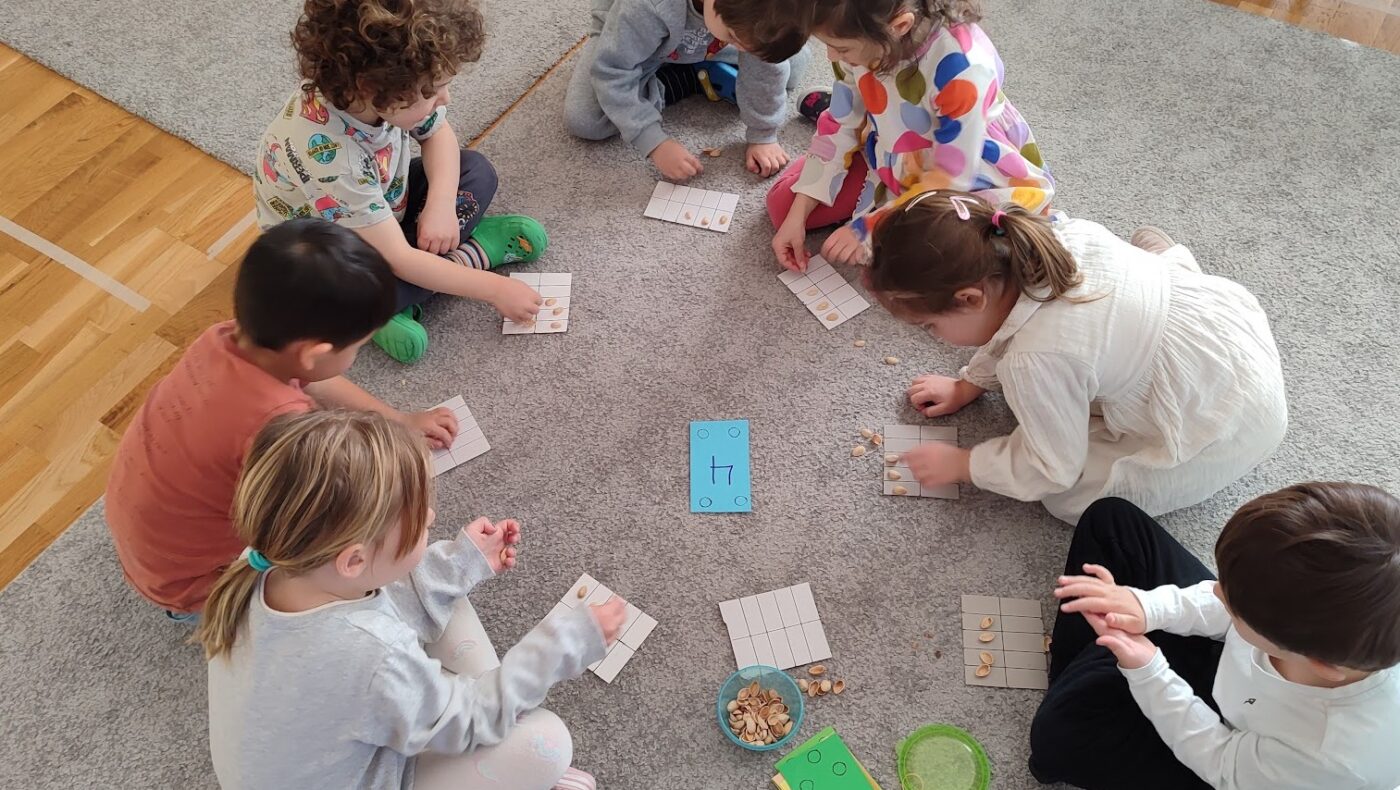
children playing math bingo

What early maths looks like in a pre school classroom

Early maths learning in pre school looks different from formal lessons: children might share blocks, compare containers or notice a repeating pattern. These everyday experiences build mathematical thinking. Knowing what to look for can help you recognise your child’s learning and ask useful questions.

What does early maths mean in pre school?

Mathematical thinking starts with everyday experiences

Early maths is more than saying numbers in order. It includes counting, comparing, recognising shapes and solving small problems. A child wondering whether there are enough cups for everyone is connecting numbers with a practical situation. Children’s mathematical understanding typically progresses through three stages: concrete (hands-on learning), pictorial (visual representation) and abstract (using numbers and symbols).

Ideas can emerge through carefully designed situations or simply in conversation, play and familiar routines. An adult might introduce a word or ask a question while the child explores materials. Read more about how play supports children’s learning.

Children develop at different paces

Children notice numbers, patterns and shapes at different times, and their confidence can vary between activities. A child who enjoys comparing tall and short towers may show little interest in counting aloud. Another may recite numbers but still be learning to count objects.

Early maths is not a fixed checklist that every child must complete at the same age. Notice what interests your child and how their understanding changes, rather than comparing them with others. If you have concerns about your child’s development, their teacher can share what they observe.

What early maths looks like during a pre school day

Teachers in many early years settings like ICCC will plan special activities that expose children to mathematical concepts and to practicing math skills. Apart from these structured situations, the examples below illustrate what you might see daily in an early-years classroom. Each connects a mathematical idea to something a child can see, touch or talk about.

Counting objects with purpose

Imagine children setting out cups for a group. One child places a cup at each seat while another counts. The activity gives counting a purpose: working out whether everyone has one.

Saying “one, two, three” is different from counting three objects. A child is learning to match one number word to each item and understand that the final number tells them how many there are altogether. They may point, move each cup aside or start again if they lose track. These are useful strategies, even when the answer is not yet accurate.

Sorting and comparing

Children might sort blocks by colour, size or shape, then compare the groups: “Which has more?” or “Do they have the same number?”

There is not just one correct way to sort. A child might group the blocks by colour, then rearrange them by size. As they explain their choice, they are noticing properties and describing a decision.

Exploring shapes and space

While building with blocks, a child might discover that a flat block makes a steadier base than a rounded one, or turn a piece to fit it into a space.

Adults can use words such as “under,” “between,” “inside” and “next to.” If a child says, “The car is there,” an adult might respond, “Yes, it is under the bridge.” This gives the child language for an idea they are already exploring.

Noticing and making patterns

A child might arrange blocks in a red-blue-red-blue sequence or join in with a repeated clap-and-stamp rhythm. They may notice what comes next, continue the pattern or create their own.

An adult can ask, “What do you notice?” to give the child room to describe what they see or hear. If the sequence changes, asking about their idea may reveal that they have chosen a new rule.

Measuring and comparing quantities

Children can explore measurement without formal units. They might pour water between containers and notice that it reaches a different height, or place two ribbons side by side to see which is longer. Words such as “full,” “empty,” “longer” and “shorter” help them describe what they find.

Pouring and checking can also challenge first impressions: a tall, narrow container may look as though it holds more than a short, wide one. For further reading, see why hands-on learning matters in the IEYC curriculum.

How adults support mathematical thinking

Ask questions that invite children to explore

A thoughtful question can help a child take an idea further without an adult taking over:

  • “How could we find out which tower is taller?”
  • “What do you notice about these groups?”
  • “What might come next in your pattern?”

Give children time to think and try an idea. Adults can offer guidance or introduce a word without immediately correcting every answer.

Build on each child’s interests and confidence

A teacher might use toy animals to explore counting with one child or compare lengths of train track with another. The starting point can feel familiar even when the mathematical ideas are different.

Children can also show understanding through gestures, pictures or their home language, as well as spoken English. You can explore ICCC’s programme and ask us how activities are adapted to children’s interests and ways of communicating.

How can you recognise progress in early maths?

Notice strategies, not just correct answers

Progress may appear in how a child approaches a problem. They might point to each object while counting, change a sorting rule or use words such as “more,” “less” and “the same.” If a tower falls, they may try a wider base. A child’s strategy can tell you as much as a correct answer about their thinking.

Ask teachers what they have observed

Your child may explore materials or interact with others at pre school in ways you do not see at home. Ask, “What kinds of activities interest my child?” or “How do they approach a problem when it is difficult?” Share what you notice at home, too.

Simple ways to explore maths at home

Use routines you already have

You do not need to recreate a pre school classroom. Try matching socks while folding laundry, counting a few pieces of fruit into a bowl or comparing containers as you put away groceries.

Keep it low-pressure: follow your child’s interest, allow them to try their own ideas and stop when the activity is no longer enjoyable.

Talk about what you notice

Everyday conversation introduces mathematical language naturally: “Your cup is fuller than mine,” “This towel is longer,” or “We need one more spoon.” Give your child a chance to respond, without turning every comment into a question.

Special equipment and formal lessons are not necessary. You can notice, compare and explore together using the materials already in front of you.

Questions to ask a pre school about early maths

Practical questions can help you picture what children do and how adults support them:

  • What kinds of materials and activities help children explore numbers, shapes and patterns?
  • How do teachers adapt activities for children with different interests or confidence levels?
  • How are observations about my child’s learning shared with parents?
  • How do you support children who are learning English alongside another language?

You could also ask for an example of how a teacher responds when a child has an idea or finds something difficult. Listen for how the adult notices the child’s thinking and offers support. You can meet the ICCC teaching team and bring your questions to a conversation with us.

Parent-child connection at ICCC international kindergarten

Simplify Parenting: Slow Down, Build Connection

Parenting in the 21st century

often feels like navigating a whirlwind. Homes overflow with toys and devices, schedules leave little room to breathe, and “quality time” with children often feels like one more item on an already full to-do list.

ICCC’s experienced teacher Ms Irina Radeva, PhD, shares how parents can make room for the things that matter most.

Less creates more

When it comes to fostering genuine connection and emotional wellbeing in children, less often creates more. Simplifying our environments, our routines, and even our expectations doesn’t mean lowering standards – it means clearing space for what truly matters: presence, curiosity, and connection.

Children develop confidence and emotional resilience not through constant stimulation or achievement, but through consistent, meaningful relationships built on shared attention, trust, and understanding. Simplicity can be the key.

Below are three ways to simplify your daily life to strengthen connection with your child – and, in the process, nurture their growing confidence and emotional intelligence.

1. Simplify the Environment: Create Space for Calm and Connection

Children thrive in spaces that are orderly, predictable, and infused with warmth. Cluttered environments – overflowing toy bins, noisy gadgets, and scattered screens – can create sensory overload and distraction, limiting a child’s ability to engage deeply with play, creativity, and social interaction.

Research in child development and environmental psychology consistently shows that calmer physical spaces support longer attention spans, greater emotional regulation, and richer imaginative play – all of which are foundations for secure connection and confidence.

💡 Try This:

  • Rotate toys intentionally. Keep only a few items available and store the rest out of sight. Rotating them every week or two renews curiosity and focus.
  • Choose open-ended materials. Blocks, scarves, cardboard boxes, and simple art supplies encourage communication, problem-solving, and cooperative play.
  • Designate calm zones. Create one or two spaces in your home that are technology-free and clutter-free – a reading corner, a nature-themed play area, or a cozy nook for talking and unwinding together.

When we simplify a child’s environment, we send an important message: you don’t need more things to feel fulfilled; you need more connection. In this calm, nurturing space, children become more attuned – to their surroundings, to others, and to themselves.

2. Simplify the Schedule: Make Room for Slow Moments and Meaningful Rhythms

Today’s children often move through their entire days with little downtime – from school to sports to structured playdates. While enrichment activities can be valuable, constant busyness leaves little room for reflection or relational connection. Children (and adults) need unstructured time – those quiet “in-between” moments where imagination, conversation, and empathy naturally unfold.

💡 Try This:

  • Build micro-pauses into your day. Take a few quiet minutes together each morning or evening. A short walk, a shared meal, or a bedtime chat can become grounding rituals.
  • Have “slow evenings.” Designate at least one evening  (or day) each week without scheduled activities. Allow space for spontaneous play or togetherness.
  • Value silence and stillness. Resist the urge to fill every gap with sound or activity. Silence invites thoughtfulness-and often, heartfelt conversation.

When we slow down, we model emotional regulation and mindfulness. Children learn that relationships aren’t rushed; they are cultivated through presence and patience. The “nothing moments” we create often become the most meaningful memories.

3. Simplify Relationships: Ten Minutes of True Presence Each Day

At its core, connection is not about the quantity of time we spend with our children but the quality of our attention. Even brief moments of undistracted presence – ten focused minutes a day – can have a profound impact on a child’s sense of security, belonging, and confidence.

These moments need not be elaborate or planned. What matters most is that they are authentic and uninterrupted. When children feel genuinely seen and heard, they internalize a deep sense of worth and self-assurance that carries into all areas of their lives.

💡 Try This:

  • Share a daily ritual of connection. Whether it’s a walk, a bedtime reflection, or a short story, consistency strengthens emotional bonds.
  • Practice attentive listening. Put away devices, make eye contact, and reflect back what your child says to show understanding.
  • Share your own experiences. Talk about your day, your challenges, or moments of gratitude. Modeling emotional openness invites children to do the same.

Presence builds trust and trust builds confidence. And confidence, in turn, nurtures resilience – the ability to adapt, communicate, and connect authentically with others.

The Science Behind Simplifying for Connection

Developmental experts emphasize that connection is the cornerstone of emotional intelligence. According to attachment theory, consistent and attuned relationships shape a child’s internal sense of safety and self-worth. When parents slow down, simplify, and tune in, children’s stress levels decrease, their capacity for empathy increases, and their communication skills strengthen naturally.

In other words, simplifying is not a retreat from modern life-it’s a return to what human development has always required: presence, stability, and relational warmth.

🌟 Final Thought

Simplifying is about doing what truly matters most. By intentionally calming our environments, slowing our pace, and focusing on meaningful connection, we create a family rhythm that nurtures both emotional health and lifelong confidence.

In a world that constantly urges us to buy more, achieve more, and move faster, the most powerful gift you can give your child isn’t more activities, more toys, or more technology. It’s more of you.

.

girl-and-boy-preparing food

The Magic of Home Routines

🏡 How Simple Home Routines Make the Start of School Easier

Creating Calm, Confidence, and Connection for Young Children

The beginning of a new school year is a big moment in any child’s life — especially for young learners. It brings fresh excitement, a sense of wonder, and the joy of discovery. But let’s be honest: it also brings change. And with change often comes a bit of chaos — rushed mornings, nervous goodbyes, and big emotions.

For young children, even small disruptions in their world can feel enormous. The transition from the comfort of home to the structure of a classroom can be overwhelming. New faces, different routines, unfamiliar surroundings — all of it can cause stress and uncertainty, even if they can’t always express it in words.

So, how can we as caregivers help children feel safe, supported, and confident as they enter this new chapter?

It starts at home — with simple, loving, predictable routines.

🌱 Why Routines Matter in the Early Years

Children, especially in the early years, thrive on predictability. When their world feels consistent and safe, they are better able to focus on what really matters — learning, playing, and growing.

Routines do more than organize time — they shape a child’s sense of safety and trust in the world.

Regular routines help children:

  • Build emotional security through predictability
  • Learn self-regulation and positive behavior
  • Develop independence and self-confidence
  • Reduce anxiety and stress during transitions
  • Create smoother, more peaceful family rhythms

A child who knows what comes next is a child who feels more in control of their day. And when life feels manageable, children are far more ready to handle challenges like a new classroom or saying goodbye at drop-off.

🏫 Why Routines Matter Even More During Back-to-School Season

When school starts, family life can suddenly feel… chaotic. Mornings are rushed. Evenings are shorter. Everyone’s adjusting.

And for little ones, this disruption can feel like a storm. That’s where home routines come in. They act like anchors — steadying the ship even when everything around it is shifting.

Home routines during the school transition provide:

  • A calm and confident start to each day
  • A soft, supportive landing when kids return home
  • Meaningful points of connection with caregivers
  • A sense of predictability in a time of big changes

The good news? You don’t need perfection. You just need consistency and connection — the two key ingredients in any successful routine.

🛏️ Three Routines to Focus on This Back-to-School Season

You don’t need an elaborate system or a perfect schedule. Instead, focus on building a few simple, sustainable routines that bring comfort, connection, and calm into your child’s daily life.

1. 🌅 The Morning Routine

A calm, connected start sets the tone for the whole day.

A helpful morning routine might look like this:

  • Wake up at the same time each day
  • A consistent flow: bathroom → get dressed → eat breakfast → pack bag
  • Use a visual schedule (especially for toddlers and preschoolers)
  • Allow 5 minutes for connection — a cuddle, a song, or a little joke
  • Keep things predictable — less rushing, more rhythm

💡 Tip: If your child resists getting dressed or eating breakfast, offer choices (“Do you want the red shirt or the blue one?”) — this helps them feel in control while still staying on track.

2. 🏡 The After-School Routine

Help your child decompress and reconnect after a busy day.

After school, children often need time to “re-regulate” — that is, to relax and return to a state of calm after navigating a day full of new stimuli.

Try:

  • A consistent “landing” activity (snack + quiet time or playtime)
  • Space to share about their day — but only when they’re ready
  • Reducing over-scheduling in the first few weeks
  • Letting them move their bodies — outdoor play or dancing can release tension

💡 Tip: Don’t worry if they don’t want to talk right away. Instead of asking, “How was your day?” try gentle, specific prompts like:

  • “What made you smile today?”
  • “Who did you sit next to?”
  • “Did anything feel tricky?”

3. 🌙 The Bedtime Routine

Healthy sleep is essential for learning, behavior, and emotional wellbeing.

A calm bedtime routine signals to your child’s brain and body that it’s time to wind down and rest.

A soothing bedtime routine might include:

  • Turning off screens 30–60 minutes before bed
  • A warm bath, pajamas, brushing teeth
  • A story or quiet cuddle time
  • Soft music or white noise if helpful
  • Lights out at the same time each night (as much as possible)

💡 Tip: Let bedtime be a moment of connection. Reading together, talking about one good thing from the day, or using a bedtime affirmation (“You are loved, you are safe, you did your best”) can help children drift off feeling safe and secure.

👨‍👩‍👧 Involve Your Child in the Process

Even toddlers can take part in building routines! The more involved they feel, the more likely they are to engage.

Here’s how:

  • Let them pick their outfit the night before
  • Use visual cues or charts they can follow themselves
  • Create “routine songs” or fun rhymes
  • Give them age-appropriate responsibilities (e.g. putting shoes by the door, placing dishes in the sink)
  • Praise their participation: “You remembered to brush your teeth all by yourself! That’s awesome.”

🧡 It’s Not About Perfection — It’s About Connection

There will be messy mornings. There will be tantrums, forgotten lunchboxes, and days when no one wants to wake up. That’s okay.

Routines aren’t about getting it right every time — they’re about providing reliable structure with a lot of love. The goal isn’t to control the day. The goal is to create predictable spaces where your child feels seen, safe, and supported — no matter what else is happening.

Flexibility and grace are just as important as consistency. Life happens. But when the rhythm of your home holds steady, your child knows they can count on you — and that’s what matters most.

✨ Final Thoughts

The first days (or weeks) of school can be a big adjustment — for kids and grown-ups alike. But creating a few simple routines at home can make that transition much smoother.

Routines offer more than just structure. They offer emotional safety, confidence, and opportunities for connection — all things young children need to thrive, especially during times of change.

With just a little planning and a lot of love, you can help your child start the school year not only ready, but resilient.

👉 Want More Tips for a Smooth Start to the School Year?

We’ll be sharing more practical tools and back-to-school resources to support you and your family.

Do you have questions?
Call or visit us.

+359 879 403 677
office@iccf-bg.com

Address: 20, Akademik Hristo Hristov Str., Dragalevtsi, Sofia 1415

Monday – Friday:
08:00 AM – 06:00 PM

Application Form

    FemaleMale

    *DATE OF BIRTH:

    *PREFERRED STARTING DATE AT SCHOOL:

    *ATTENDANCE PLAN: 5 full days5 mornings (LLB and BBB only)


    MOTHER'S INFORMATION


    FATHER'S INFORMATION


    *What language(s) is /are spoken at home?

    *Does your child speak English?

    *Does father speak English?

    *Does mother speak English?

    Have you already visited ICCC?

    If yes, when did you visit? If not, are you able to visit and when?

    Has the child been in a nursery / pre-school before? YesNo

    If yes, please give details below:

    HEALTH: Please indicate any medical concern of which the centre should be aware of (allergies, illness, medication, etc.)

    How did you hear about ICCC?


    ICCC Membership is annual and is paid in full for the school year in attendance (September – June). Attendance in July and August is optional. When a child joins after the start of the school year the fee is calculated proportionally. There is no discount for longer absences for holidays or other reasons.

    ICCC is open 12 months a year between the hours of 8.00a.m. to 18.00p.m.. While all care and attention will be given to safeguard the children during these hours, the Center will not be responsible for any injury caused beyond the control of staff. No responsibility will be taken outside working hours.

    ICCC admits children based on space availability and age. Priority is given to siblings, English native speakers and expat families.

    Copyright © 2022 Sofia’s First English Kindergarten Founded By Expats in 1997. All Rights Reserved