
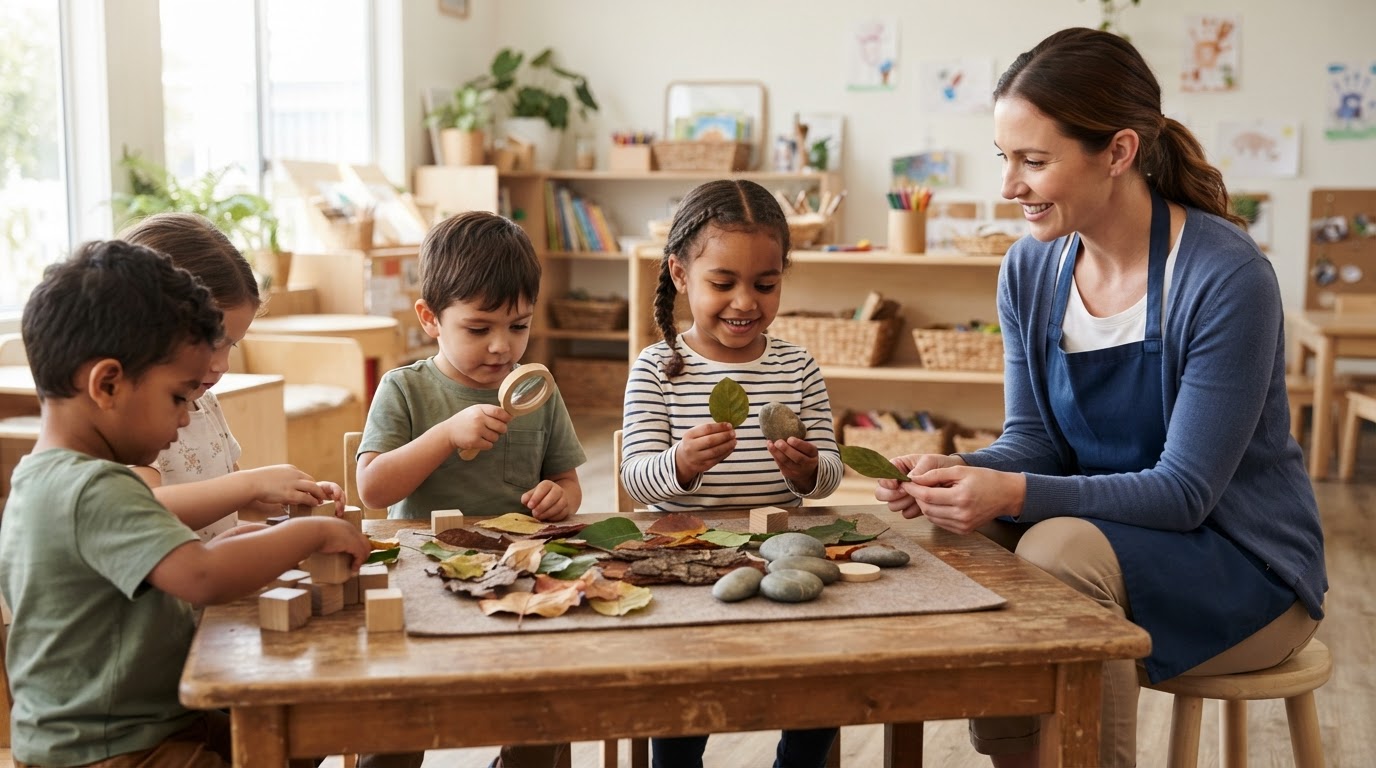
Choosing a pre-school can feel uncertain, particularly when the language used to describe a curriculum is unfamiliar. You may be wondering, “What will my child actually do and learn during the day?” The IEYC curriculum gives educators a framework for planning experiences around young children’s development, including opportunities to learn by exploring and doing. Understanding how that works in practice can help you ask useful questions and feel more confident about your choice.
What is the IEYC curriculum?
The idea behind the International Early Years Curriculum
The International Early Years Curriculum, or IEYC, is a framework designed for children typically aged two to five/six years. Developed by Fieldwork Education, it helps educators plan learning experiences that reflect how young children develop, explore and interact with the world around them.
A curriculum is not simply a list of activities or a timetable that requires every child to achieve the same thing at the same moment. In the IEYC curriculum, educators use a shared framework to guide their planning and observations while responding to the children in their care. One child may be ready to describe an idea in detail; another may first need time to watch, touch or explore alongside an adult.
For parents, the distinction is useful: the framework provides direction, but the quality of a child’s experience also depends on how educators put it into practice. At ICCC we often need to adapt our approach depending on the English language skills of the children in the class, and very importantly, based on how children respond to the topic and whether it sparks interest and exploration.
How learning goals and activities work together
A learning goal describes what educators hope to support – example s of learning goals could be extending children’s knowledge and understanding of the natural world, or their mathematical thinking; an activity provides a way for children to explore and progress towards the learning goal. For example, if children sort a collection of leaves, they might notice differences in shape, make choices about how to group them and describe what they see. An educator can listen to their explanations and offer words or questions that extend their thinking: why leaves are different shapes and sizes, what makes a leaf fall from the tree, etc.; or can ask why they chose to group certain leaves together (mathematical thinking). The same activity can lead to different learning experiences for different children and support the development of multiple learning goals.
What does hands-on learning look like in an early-years classroom?
Children explore materials, ideas and questions
Hands-on learning for young children might involve building with blocks, exploring water, making marks with crayons or investigating natural objects. A child who stacks blocks is not necessarily following a set of instructions. They may be testing which pieces balance, deciding how tall to build and noticing what happens when the structure falls.
Often, the learning happens as a child returns to an idea. They might rebuild the tower with a wider base, watch another child’s approach or talk about what changed. These experiences should be selected with children’s ages, safety and individual needs in mind, with appropriate supervision and materials that are suitable for the group.
Active learning in pre-school includes both play / exploration, and activities designed by teachers with a specific purpose in mind. The IEYC curriculum gives educators a way to connect different kinds of experiences with broader learning intentions. To explore the relationship between play and learning further, you can learn more about the power of play. You ca also ask educators about examples of what hands-on learning takes place in their classroom.
Educators guide without taking over
The adult’s role begins before an activity starts. Educators can choose materials, arrange an accessible space and consider what children may already know or be interested in. During the experience, they observe, offer reassurance and decide when a question or a little practical help might be useful.
Imagine a tower repeatedly falling over. Instead of rebuilding it for the child, an educator might sit nearby and ask, “What could we do to try to stop the tower falling?” They could offer a larger block, demonstrate how to steady the base or give the child time to test an idea. Guided exploration leaves room for children’s choices while ensuring an adult is available to support them.
This does not mean that every moment is unstructured. An educator may introduce a shared experience, set a clear safety boundary or bring children together to discuss what they noticed. ICCC’s teachers balance guidance with children’s own ideas.
Why hands-on learning matters for young children
It helps children make sense of new ideas
Ideas that sound abstract can become easier to explore when children can see, move and discuss real objects. While pouring water between containers, for example, a child can encounter the ideas of “full” and “empty” in a way that connects words to an immediate experience. An educator might ask which container has more room or introduce new vocabulary as the child plays.
That does not mean every child has one fixed “learning style” or must learn through touch. Children can make connections in many ways, including through conversation, movement, observation, stories and repeated experiences. The IEYC curriculum can support a range of these approaches rather than relying on a single way of participating.
It creates opportunities to communicate and work with others
When children share materials, they have natural reasons to communicate. Two children building a road may suggest where it should go, ask for a block or explain why a bridge needs support. With an educator’s help, they can also practise listening to another idea and finding a way forward when they want different things. Children also learn new language when interacting in play with their friends or teachers.
Participation will not look the same for everyone. A child might point, use a gesture, speak in a familiar language, watch quietly or explore alone before joining a group. These are all useful things for educators to notice. A supportive approach makes space for different ways of communicating rather than treating the most talkative child as the only engaged learner.
It supports confidence, curiosity and problem-solving
Trying something, changing an approach and trying again can give a child experience of working through a manageable challenge. A ramp that does not send a ball very far might prompt them to change its height or choose another surface. A nearby adult can make the experience feel safe by acknowledging frustration and helping the child decide what to try next.
These opportunities do not guarantee a particular outcome or mean confidence will develop on a fixed timetable. Children vary in how readily they approach unfamiliar tasks, and a child who is comfortable one day may need more reassurance the next. The aim is to offer support and time, not to pressure a child to perform.
How educators make hands-on experiences purposeful
Planning around children’s interests and development
Thoughtful planning starts with knowing the children. If a group is interested in things that move, an educator might offer objects to push, pull or roll. The same broad idea can be adapted: one child may enjoy watching an adult demonstrate, while another may be ready to compare objects and explain a prediction.
In an IEYC curriculum setting, adaptation can also mean offering a simpler starting point, fewer choices or a different way to take part. A child who is not ready to describe a pattern aloud might point to matching objects. A child learning the classroom language might benefit from gestures, familiar words or a peer’s example. Individual attention helps make an experience accessible without assuming that every child needs the same support.
Observing progress and sharing it with parents
Educators learn a great deal by noticing what children do during ordinary experiences. They might observe the questions a child asks, the choices they make, a skill they are beginning to use or how they respond when an adult offers help. Over time, these observations can help educators decide whether to repeat an experience, add a challenge or offer more reassurance.
As a parent, at ICCC you receive daily news from classroom life. Parents are encouraged to share what they notice at home, including interests, changes in routine or concerns. An open exchange, together with observation, structured assessment and progress reports, gives both parents and educators a fuller picture of the child.
Questions to ask when considering an IEYC pre-school
Ask how the curriculum becomes part of the day
A curriculum description is a useful starting point, but examples can help you understand what your child’s day might feel like. When you visit or speak with a school, ask staff to describe a recent or typical experience and explain what they were hoping children might explore.
Ask how the school works with families
Your child’s sense of security matters alongside the experiences offered in the classroom. If a setting or activity is unfamiliar, you may want to know how staff make space for a child to settle at their own pace. Questions about communication also help you understand how you and the school can work together:
Frequently asked questions about the IEYC curriculum
Is the IEYC curriculum only about play?
No. Play and exploration are important ways for young children to encounter ideas, but they sit alongside educator planning, observation and guidance. Children may learn through stories, conversations, creative work, movement and shared routines as well as through play. The important question is how these experiences are chosen and supported, not whether every moment looks like a formal lesson.
Does hands-on learning mean children do not have structure?
No. Hands-on learning can take place within clear routines, learning goals and safety boundaries. An educator might introduce an activity, explain how to use the materials safely and bring children together afterward, while still leaving room for them to make choices and test ideas. Structure and exploration can support each other.
How can I tell whether my child is benefiting?
You might notice your child showing curiosity, communicating an idea, returning to an activity or becoming more willing to participate. Progress can be gradual and may look different at home and at school, so one quiet day does not tell the whole story. Ask educators what they have noticed over time and discuss any questions or concerns. They can help you understand your child’s experiences in context.
Can I support this kind of learning at home?
Yes. You do not need to recreate a classroom or buy special materials. Follow their interest, talk about their choices and bring in your ideas and questions. The connection and conversation matter more than getting an answer right.
Finding an approach that feels right for your child
Look for an approach that combines opportunities to explore with thoughtful educator guidance, individual attention and a willingness to work with families. The IEYC curriculum provides a framework; understanding how a school uses it will help you picture your child’s experience more clearly.
If you would like to know more, you can explore ICCC’s programme or contact us with your questions. A practical conversation about everyday experiences, support and communication can be a reassuring next step.

Snezhana Daneva is a Director at ICCC since September 2010. She gained experience in teaching, marketing and client relations, as well as cultural diplomacy and regional project management after a diverse career at the British Council in Bulgaria and in the UK. She worked as a volunteer in not-for-profit organizations related to child birth and child care.
Snezhana has MA in Education Management and MA in English and American Studies from Sofia University, and Management Certificate and Diploma from Open University, UK. Her recent Education Management degree thesis focused on children’s social-emotional development in the early years, comparing government standards and practice in Bulgaria and in the United Kingdom.