
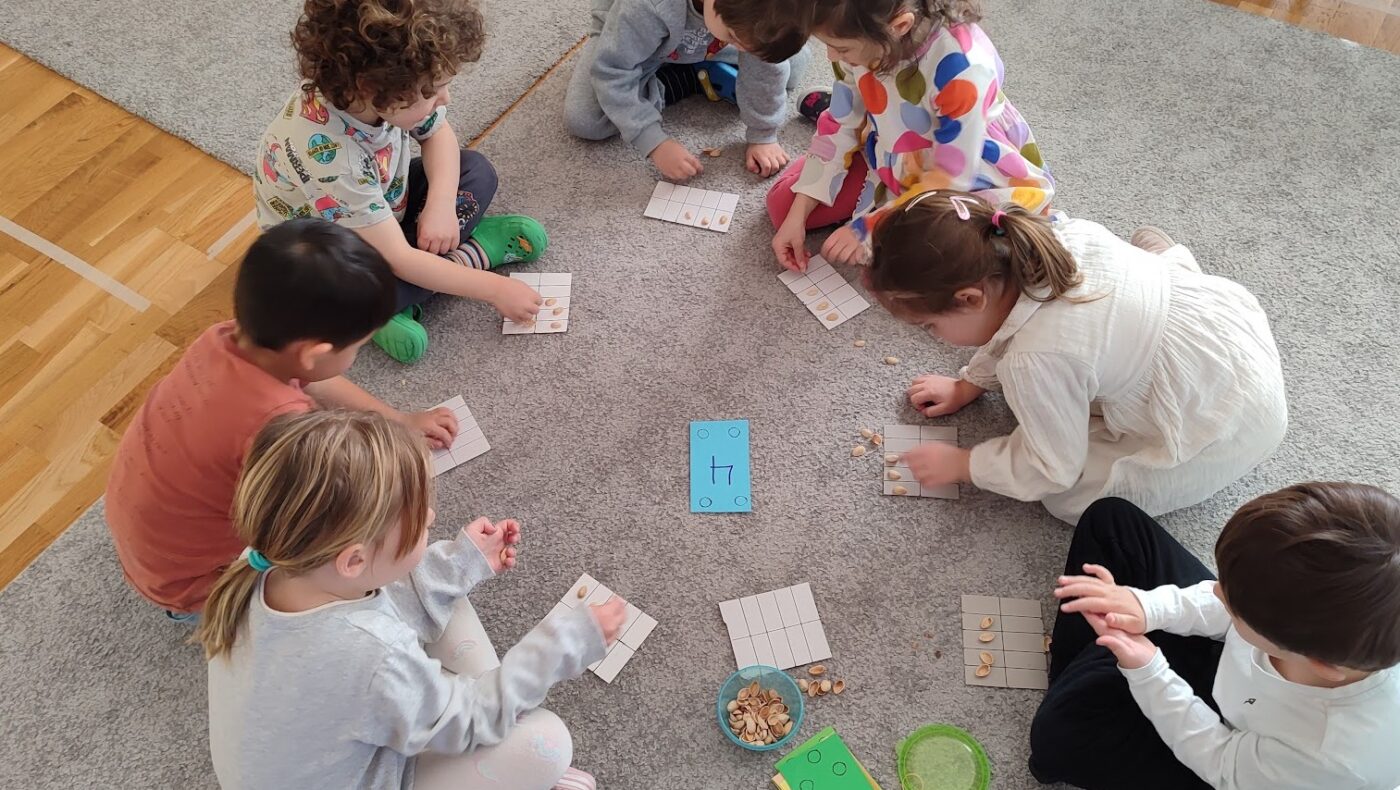
Early maths learning in pre school looks different from formal lessons: children might share blocks, compare containers or notice a repeating pattern. These everyday experiences build mathematical thinking. Knowing what to look for can help you recognise your child’s learning and ask useful questions.
What does early maths mean in pre school?
Mathematical thinking starts with everyday experiences
Early maths is more than saying numbers in order. It includes counting, comparing, recognising shapes and solving small problems. A child wondering whether there are enough cups for everyone is connecting numbers with a practical situation. Children’s mathematical understanding typically progresses through three stages: concrete (hands-on learning), pictorial (visual representation) and abstract (using numbers and symbols).
Ideas can emerge through carefully designed situations or simply in conversation, play and familiar routines. An adult might introduce a word or ask a question while the child explores materials. Read more about how play supports children’s learning.
Children develop at different paces
Children notice numbers, patterns and shapes at different times, and their confidence can vary between activities. A child who enjoys comparing tall and short towers may show little interest in counting aloud. Another may recite numbers but still be learning to count objects.
Early maths is not a fixed checklist that every child must complete at the same age. Notice what interests your child and how their understanding changes, rather than comparing them with others. If you have concerns about your child’s development, their teacher can share what they observe.
What early maths looks like during a pre school day
Teachers in many early years settings like ICCC will plan special activities that expose children to mathematical concepts and to practicing math skills. Apart from these structured situations, the examples below illustrate what you might see daily in an early-years classroom. Each connects a mathematical idea to something a child can see, touch or talk about.
Counting objects with purpose
Imagine children setting out cups for a group. One child places a cup at each seat while another counts. The activity gives counting a purpose: working out whether everyone has one.
Saying “one, two, three” is different from counting three objects. A child is learning to match one number word to each item and understand that the final number tells them how many there are altogether. They may point, move each cup aside or start again if they lose track. These are useful strategies, even when the answer is not yet accurate.
Sorting and comparing
Children might sort blocks by colour, size or shape, then compare the groups: “Which has more?” or “Do they have the same number?”
There is not just one correct way to sort. A child might group the blocks by colour, then rearrange them by size. As they explain their choice, they are noticing properties and describing a decision.
Exploring shapes and space
While building with blocks, a child might discover that a flat block makes a steadier base than a rounded one, or turn a piece to fit it into a space.
Adults can use words such as “under,” “between,” “inside” and “next to.” If a child says, “The car is there,” an adult might respond, “Yes, it is under the bridge.” This gives the child language for an idea they are already exploring.
Noticing and making patterns
A child might arrange blocks in a red-blue-red-blue sequence or join in with a repeated clap-and-stamp rhythm. They may notice what comes next, continue the pattern or create their own.
An adult can ask, “What do you notice?” to give the child room to describe what they see or hear. If the sequence changes, asking about their idea may reveal that they have chosen a new rule.
Measuring and comparing quantities
Children can explore measurement without formal units. They might pour water between containers and notice that it reaches a different height, or place two ribbons side by side to see which is longer. Words such as “full,” “empty,” “longer” and “shorter” help them describe what they find.
Pouring and checking can also challenge first impressions: a tall, narrow container may look as though it holds more than a short, wide one. For further reading, see why hands-on learning matters in the IEYC curriculum.
How adults support mathematical thinking
Ask questions that invite children to explore
A thoughtful question can help a child take an idea further without an adult taking over:
- “How could we find out which tower is taller?”
- “What do you notice about these groups?”
- “What might come next in your pattern?”
Give children time to think and try an idea. Adults can offer guidance or introduce a word without immediately correcting every answer.
Build on each child’s interests and confidence
A teacher might use toy animals to explore counting with one child or compare lengths of train track with another. The starting point can feel familiar even when the mathematical ideas are different.
Children can also show understanding through gestures, pictures or their home language, as well as spoken English. You can explore ICCC’s programme and ask us how activities are adapted to children’s interests and ways of communicating.
How can you recognise progress in early maths?
Notice strategies, not just correct answers
Progress may appear in how a child approaches a problem. They might point to each object while counting, change a sorting rule or use words such as “more,” “less” and “the same.” If a tower falls, they may try a wider base. A child’s strategy can tell you as much as a correct answer about their thinking.
Ask teachers what they have observed
Your child may explore materials or interact with others at pre school in ways you do not see at home. Ask, “What kinds of activities interest my child?” or “How do they approach a problem when it is difficult?” Share what you notice at home, too.
Simple ways to explore maths at home
Use routines you already have
You do not need to recreate a pre school classroom. Try matching socks while folding laundry, counting a few pieces of fruit into a bowl or comparing containers as you put away groceries.
Keep it low-pressure: follow your child’s interest, allow them to try their own ideas and stop when the activity is no longer enjoyable.
Talk about what you notice
Everyday conversation introduces mathematical language naturally: “Your cup is fuller than mine,” “This towel is longer,” or “We need one more spoon.” Give your child a chance to respond, without turning every comment into a question.
Special equipment and formal lessons are not necessary. You can notice, compare and explore together using the materials already in front of you.
Questions to ask a pre school about early maths
Practical questions can help you picture what children do and how adults support them:
- What kinds of materials and activities help children explore numbers, shapes and patterns?
- How do teachers adapt activities for children with different interests or confidence levels?
- How are observations about my child’s learning shared with parents?
- How do you support children who are learning English alongside another language?
You could also ask for an example of how a teacher responds when a child has an idea or finds something difficult. Listen for how the adult notices the child’s thinking and offers support. You can meet the ICCC teaching team and bring your questions to a conversation with us.

Snezhana Daneva is a Director at ICCC since September 2010. She gained experience in teaching, marketing and client relations, as well as cultural diplomacy and regional project management after a diverse career at the British Council in Bulgaria and in the UK. She worked as a volunteer in not-for-profit organizations related to child birth and child care.
Snezhana has MA in Education Management and MA in English and American Studies from Sofia University, and Management Certificate and Diploma from Open University, UK. Her recent Education Management degree thesis focused on children’s social-emotional development in the early years, comparing government standards and practice in Bulgaria and in the United Kingdom.